IEEPA Tariff Refund 2026: The $175 Billion Question Nobody Wanted to Ask
The Supreme Court struck down IEEPA tariffs in February 2026. A federal judge just ordered CBP to begin the $175 billion refund process. Here is what CFOs and enterprise finance leaders must do right now.

Chansam Kim
March 11, 2026
Co-Authored with Drew Adler, Product Marketing
Picture the scene inside a mid-sized filtration manufacturer in Nashville in the spring of 2025. Containers arriving at port. Tariff bills landing like they always do. Duty payments going out, logged, forgotten. Nobody celebrates paying import duties. You just pay them and move on.
Except this company did not move on. They filed suit. And eighteen months later, their case sits at the top of a federal court order that could unlock the largest tariff refund in American history.
If your company has been importing goods into the United States since early 2025, there is a meaningful chance the federal government owes you money. How much, exactly when, and through precisely what process remains genuinely contested. But something shifted this week that every CFO and finance lead needs to understand, because the IEEPA tariff refund story took a turn that changes your calculus.
How IEEPA Tariffs Were Imposed — and Why the Supreme Court Struck Them Down
To understand the IEEPA tariff refund situation, you have to go back to a statute that most Americans have never heard of: the International Emergency Economic Powers Act of 1977. IEEPA was written during the Cold War as a tool for freezing assets, blocking transactions, and strangling the financial lifelines of adversaries. It was the kind of law that got invoked quietly, surgically, against rogue states and sanctions targets.
Starting in early 2025, the U.S. administration did something different with it. They declared a national economic emergency, pointed to IEEPA, and used it to impose sweeping tariffs on nearly every country in the world. A 10 percent baseline on almost all imports. Higher rates on dozens of trading partners. Twenty-five percent on certain goods from Canada and Mexico. All of it built on two words in that 1977 statute: "regulate importation."
Trade lawyers read those words and raised an eyebrow. Importers paid the bills and hired those lawyers. And one small educational toy company in suburban Chicago, Learning Resources, Inc., became the unlikely protagonist of a case that would end up in front of the Supreme Court.
"Based on two words separated by 16 others in IEEPA, the President asserts the independent power to impose tariffs on imports from any country, of any product, at any rate, for any amount of time. Those words cannot bear such weight." — Chief Justice John Roberts, February 20, 2026
On February 20, 2026, the U.S. Supreme Court ruled 6–3 in a challenge brought by Learning Resources, Inc. that IEEPA does not authorize tariffs. The Court held that the power to tax imports belongs to Congress under Article I of the Constitution. As a result, the IEEPA tariffs were declared unconstitutional. Tariff collections stopped on February 24. Across corporate finance departments, companies began reviewing their import records and asking the obvious question: what about the money already paid?
The Supreme Court's opinion did not address the question of refunds.
The Silence That Launched 1,000 Tariff Refund Lawsuits
When a court strikes down a statute, it does not automatically write the refund check. Especially not when the number approaches $175 billion.
The Supreme Court's February opinion was six pages of constitutional law and exactly zero sentences about reimbursement. That silence was not an accident. Refunds of this scale implicate CBP's administrative systems, congressional appropriations, and procedural questions that courts typically leave to lower courts to untangle. The Justices handed the problem down the chain and said, in essence: figure it out.
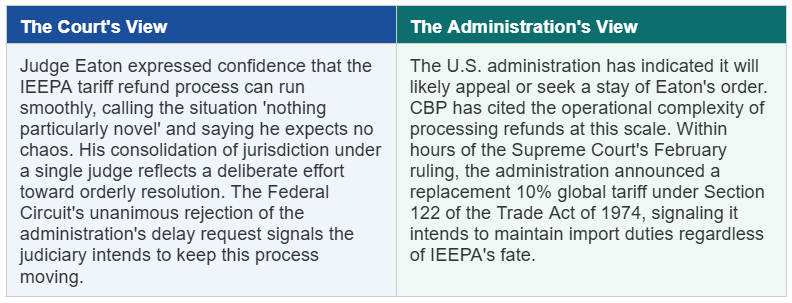
What followed was the kind of institutional scramble that trade compliance professionals recognize. More than 1,000 companies filed tariff refund lawsuits in the U.S. Court of International Trade (CIT). The Trump administration asked the Court of Appeals for a four-month delay to think things over. The U.S. Court of Appeals for the Federal Circuit said no, all eleven judges agreeing, including four who had previously ruled against the importers on the merits.
The Court Order That Started the IEEPA Tariff Refund Process
Judge Eaton's order was three pages long. In Washington terms, that is haiku. But every sentence mattered.
First, he established jurisdiction, declaring himself the sole CIT judge who will hear all IEEPA tariff refund cases. In a landscape where more than a thousand separate lawsuits were multiplying like fissures in old concrete, this was the decision to pour the foundation before the whole structure collapsed into chaos.
Second, he ordered Customs and Border Protection to complete a process called liquidation for all affected entries, without including the invalidated tariff charges. Think of CBP liquidation as closing the books on an import transaction. Until it is done, a refund cannot be calculated. Eaton told CBP to do it cleanly. For entries already liquidated with the bad IEEPA charges baked in, he said redo it. That reliquidation step is the gateway to every refund dollar.
Third, and perhaps most important for the thousands of companies that filed protective lawsuits just in case, Eaton said the ruling applies to all importers of record, not just the litigants. Every company that paid IEEPA tariffs is, in the judge's words, entitled to benefit.
Then, on Friday March 6, the story moved again. CBP filed a declaration with the court acknowledging it is struggling to comply quickly given the scale of the task. But rather than throwing up its hands, CBP said it is building a new automated system inside its ACE (Automated Commercial Environment) platform that would let importers file refund declarations directly. CBP would verify the transactions, recalculate duties without the IEEPA charges, add interest, and issue refunds electronically through the Treasury. The agency estimates this new system could be ready in 45 days and would save CBP over four million hours compared to processing everything manually.
That 45-day figure is the most concrete timeline anyone has offered in this saga. Whether it holds is a separate question.
How Much Is the IEEPA Tariff Refund Worth? The Numbers Behind the Uncertainty
Let us be direct about scale, because the figures in this story can start to feel abstract.
CBP collected approximately $134 billion in IEEPA-based duties through the end of 2025, with additional collections through February 24, 2026.
The Penn Wharton Budget Model estimates total IEEPA tariff refund exposure at up to $175 billion when accounting for all affected entries.
Major corporations including Bausch & Lomb, Dyson, FedEx, and L'Oréal have already filed tariff refund lawsuits.
IEEPA fentanyl tariffs applied from February 4, 2025; reciprocal tariffs applied from April 2, 2025. Both are eligible for refund through February 24, 2026.
When CBP issues refunds following reliquidation, it typically adds interest at the IRS underpayment rate, currently around 5 to 6 percent annually. For large refunds, that interest is material.
For context: $175 billion is roughly the GDP of New Zealand. It is more than Apple's annual net income. It is a number that strains CBP's administrative infrastructure in ways that no one has fully mapped yet, because nothing like this has ever happened before.
For your company specifically, the math is more straightforward. Look at your import volume between February 4, 2025 and February 24, 2026. Identify which entries carried IEEPA-based duties under HTS codes beginning with 9903.01.xx (fentanyl tariffs) and 9903.02.xx (reciprocal tariffs). That is your potential IEEPA tariff refund. If your procurement team absorbed those costs without fully passing them through to customers, this is not a footnote in the trade compliance report. It is a line item worth putting in front of the board.
For finance leaders who spent the last year treating tariff costs as a cost of doing business, the uncomfortable realization is this: some of that money may never have been owed. And the process to get it back is now, officially, underway.
IEEPA Tariff Refund Timeline and Key Unresolved Questions
Here is the part where any advisor worth their retainer will slow down and be straight with you. This story is not resolved. The order is real, the entitlement is established, but the road between here and a wire transfer to your account runs through terrain that has never been navigated at this scale.
WHEN WILL IEEPA TARIFF REFUNDS ACTUALLY BE PAID?
CBP's new ACE system is projected to be ready in 45 days, putting the earliest realistic refund processing window at mid-April to May 2026. However, if the administration successfully seeks a stay of Eaton's order, that timeline extends. A conservative planning range is Q3 2026 for the first refunds to flow, with the bulk of processing stretching into 2027. Do not build Q2 cash flow projections around IEEPA refunds.
DO I NEED TO HAVE FILED A LAWSUIT TO GET A REFUND?
Judge Eaton says no. All importers of record are entitled to benefit. But implementation procedures have not been published, and some experienced trade lawyers are still advising clients to file protective CIT actions precisely because 'entitled' in a court order and 'will receive' in a CBP wire transfer are two different things. The procedural details, when they arrive, will determine whether that caution was necessary.
WHAT IS THE 180-DAY PROTEST DEADLINE AND DOES IT AFFECT MY REFUND?
CBP's standard protest window for challenging a liquidation entry is 180 days. Some entries from the early IEEPA tariff period are already bumping against that deadline. Entries liquidated within the past 180 days can be protested under 19 U.S.C. Section 1514. Entries beyond that window may require a CIT action. Your trade counsel should be mapping your specific entry dates against this window immediately.
ARE REPLACEMENT TARIFFS ALREADY IN PLACE?
Yes. Within hours of the Supreme Court ruling, the administration announced a 10 percent global tariff under Section 122 of the Trade Act of 1974. Section 122 carries a hard ceiling of 15 percent and expires after 150 days (around July 24, 2026), unless Congress acts to extend it. Additional Section 301 investigations are underway. Your tariff exposure did not go to zero on February 20. The IEEPA refund conversation and the forward tariff exposure conversation must run on parallel tracks in your finance and compliance team.
WILL THE ADMINISTRATION APPEAL OR SEEK A STAY?
Almost certainly yes, based on their stated position at the March 5 hearing. The open question is whether they can get a stay that actually delays CBP's liquidation obligations. Legal observers are split. Finance teams should model a scenario where this extends into late 2026 or beyond.
How to Claim Your IEEPA Tariff Refund: A CFO Action Plan
The companies that recover the most, the fastest, will be the ones that treated this week's order as a starting gun. Here is what that looks like in practice:
STEP 1: PULL YOUR IEEPA ENTRY INVENTORY FROM ACE
Register for or log into your CBP ACE portal account. Run the Entry Summary details report (ES-003) and filter for HTS codes beginning with 9903.01.xx and 9903.02.xx. Export to a spreadsheet. Categorize each entry by liquidation status: unliquidated entries are Post-Summary Correction eligible; entries liquidated within 180 days can be protested; entries beyond 180 days may require CIT action. Each category requires a different response and has different urgency.
STEP 2: ENROLL IN CBP'S ACH REFUND PROGRAM
As of February 6, 2026, CBP requires importers to enroll in the ACH Refund program by submitting U.S. banking details to receive refunds electronically. If your company is not enrolled, the refund has nowhere to go. This is a five-minute administrative task that should happen today.
STEP 3: PRESERVE ALL SUPPORTING DOCUMENTATION
CBP will require documentation to verify and process reliquidations and refunds. Customs entry documents, entry summaries, commercial invoices, packing lists, bills of lading, and proof of tariff payment all need to be organized and retained. Do not assume your customs broker has a complete set. Verify it.
STEP 4: TALK TO TRADE COUNSEL ABOUT YOUR PROTEST AND CIT OPTIONS
If your company has not filed a CIT action, discuss with trade counsel whether to do so now. Filing a protective action is a relatively low-cost way to preserve your options if non-litigant treatment turns out to be narrower than Eaton's order suggests. Review your liquidation dates against the 180-day protest window before anything else.
STEP 5: ASSIGN SOMEONE TO MONITOR CBP IMPLEMENTATION GUIDANCE
CBP's new ACE refund system is expected within 45 days. When it arrives, the filing procedures will matter. Assign a name inside your organization to monitor CBP bulletins and CIT orders, because that guidance will arrive without fanfare and the window to act promptly may be narrow.
STEP 6: MODEL BOTH SCENARIOS FOR YOUR BOARD
Build a cash flow scenario that assumes IEEPA tariff refunds arrive in Q3 2026. Build a second scenario that assumes the administration successfully delays the process into 2027. The range of outcomes is genuinely wide, and your board deserves to see both ends of it, including the interest accrual upside if the timeline extends.
The Larger Story: What This Means for Trade Compliance as a Finance Function
Step back for a moment from the procedural machinery and consider what this moment actually represents.
A small educational toy company challenged the federal government's claim to a sweeping emergency tariff power. A Nashville filtration manufacturer joined them. Thousands of other companies, large and small, followed. They went to a trade court, then an appeals court, then the highest court in the land. And they won.
Chief Justice Roberts wrote that the power to tax imports is so clearly a branch of the taxing power that Congress could not have handed it away in a 1977 emergency statute without saying so explicitly. The President, he said, cannot reach that far on two words.
That is a civics lesson delivered at scale. But the operational lesson for CFOs is different, and arguably more durable: the companies that knew their IEEPA tariff exposure in real time, that had their entry data organized, that had trade counsel relationships already in place, were the ones that moved first when the ruling came down. The companies that found out about IEEPA refunds by reading a news alert three days later are the ones scrambling now.
Trade compliance has spent years as the department nobody visited unless something went wrong. The events of the past six weeks are a permanent argument for changing that. Trade compliance is not a customs housekeeping function. For enterprise finance, it is a revenue recovery function.
How Sail GTX Helps Enterprise Finance Teams Navigate IEEPA Tariff Refunds
We have been tracking this case since the first filings in the Court of International Trade in 2025. Our team monitors CBP bulletins, CIT docket updates, and policy developments related to how the refund process may be implemented.
For companies using the Sail GTX platform, import entry data, tariff classifications, and regulatory references are organized into a single structured trade data workspace. This allows finance and compliance teams to quickly identify which entries may have been affected by IEEPA tariffs.
The platform also reconstructs the full tariff stack applied to each import transaction — including measures such as Section 301, Section 232, IEEPA duties, and other applicable tariffs — together with the original date of entry. This makes it possible to estimate potential refund exposure and analyze historical tariff impact across thousands of entries.
SAIL can also generate audit-ready documentation that traces how tariff classifications and duty calculations were determined, helping companies prepare supporting records for internal review, trade counsel analysis, or potential CBP inquiries.
If you are currently managing this process through spreadsheets and customs broker emails, you already know how fragmented that workflow can be. The question is whether the potential IEEPA tariff recovery in this case justifies building better infrastructure for the next event. Based on what we are seeing, the next one may not be far away.
We will continue publishing updates as CBP guidance becomes clearer and as the refund process develops. This story is still unfolding.
Frequently Asked Questions: IEEPA Tariff Refunds
WHAT IS THE IEEPA TARIFF REFUND?
The IEEPA tariff refund refers to the return of import duties collected by the U.S. government under the International Emergency Economic Powers Act between February 4, 2025 and February 24, 2026. The Supreme Court ruled those tariffs unconstitutional on February 20, 2026. A federal judge has since ordered CBP to begin the refund process for all importers of record who paid those duties.
WHO IS ELIGIBLE FOR IEEPA TARIFF REFUNDS?
Judge Richard Eaton of the U.S. Court of International Trade ruled on March 5, 2026 that all importers of record whose entries were subject to IEEPA duties are entitled to refunds, not just those who filed individual lawsuits. Eligibility covers both the fentanyl-related tariffs (effective February 4, 2025) and the reciprocal tariffs (effective April 2, 2025), through February 24, 2026.
HOW LONG WILL IEEPA TARIFF REFUNDS TAKE?
CBP has told the Court of International Trade it is building a new automated ACE system to process refunds, with a projected readiness of 45 days from March 6, 2026. However, the U.S. administration has indicated it may appeal or seek a stay of the court's order. A conservative estimate for the first refunds to be disbursed is Q3 2026, with full processing extending into 2027.
DO I NEED TO FILE A LAWSUIT TO GET MY IEEPA TARIFF REFUND?
Based on Judge Eaton's March 5 order, no. All importers of record are entitled to benefit regardless of whether they filed suit. However, many trade lawyers advise filing a protective CIT action as a precaution, given that administrative implementation procedures have not yet been published. Consulting trade counsel on your specific entry dates and liquidation status is advisable.
WHAT ARE THE DEADLINES I NEED TO KNOW FOR IEEPA TARIFF REFUNDS?
The critical deadline is the 180-day protest window under 19 U.S.C. Section 1514. Entries liquidated within 180 days of today can be protested with CBP. Entries beyond that window likely require a CIT action. Unliquidated entries may be eligible for Post-Summary Corrections. Entries from May through October 2025 are now in the highest-risk window, representing the largest refund opportunity and the tightest procedural deadlines simultaneously.
About Sail GTX: Sail GTX is an AI-native global trade compliance platform built for enterprise importers and their finance teams. We help organizations manage tariff classification, duty exposure, and compliance workflows across complex global supply chains.
Disclaimer: This post is for informational purposes only and does not constitute legal or tax advice. Companies should consult qualified trade counsel regarding their specific circumstances.
Tagged with
Ready to transform your Trade Compliance?
See how SAIL can help you classify faster and stay compliant.
Related Articles
Canada's Counter-Tariffs Are Now Live — and the U.S. Answered With Import Bans: Why US-Canada Trade Is Now a Three-Layer Exposure Problem
Canada's counter-tariffs are live and the U.S. answered with import bans. What's banned, what's taxed, and what trade teams need to check now.
Multi-Country Classification Is Now Live: What SAIL's US, Canada, EU and the UK Expansion Means for Trade Teams
"SAIL's classification now spans the US, Canada, EU and UK — as CBAM, steel tariffs, and de minimis rules all shift in 2026." (120 chars)
US-Canada Trade Tensions Escalate: What the New Tariffs Mean for Trade, Finance, and Supply Chain Teams
US-Canada tariffs hit 50% this week, with autos and steel set to double again in 2027. What trade, finance, and supply chain teams should do now.