The $166 billion opportunity —and what comes next for US import tariffs
$166B in tariff refunds are now being paid out, but they're not automatic. Here's what importers must do now, and what new duties may come next.

Chansam Kim
May 8, 2026
Next week, the US government will begin disbursing refunds on import duties that the Supreme Court ruled were unlawfully collected. For importers who paid duties under the International Emergency Economic Powers Act (IEEPA), the window to claim those funds is now open. At the same time, the regulatory environment is actively shifting with multiple new tariff mechanisms under development that could materially affect import costs later this year. This article covers both: how to act on the current refund opportunity, and how to prepare for what may come next.
$166B Estimated duties subject to refund
~21% Of refund claims accepted by CBP as of April 28
60–90 Days from claim acceptance to expected payment
Background: what triggered the refunds
In February 2026, the US Supreme Court ruled that a set of broad-based import tariffs imposed under IEEPA exceeded the law's statutory authority. The US Court of International Trade subsequently ordered CBP to refund all duties collected under those provisions. According to CBP, more than $150 billion in IEEPA duties were collected between April 2025 and the ruling and with statutory interest, the total refund obligation stands at an estimated $166 billion.
On April 20, CBP launched the CAPE portal (Consolidated Administration and Processing of Entries), the official electronic mechanism for submitting claims through the ACE system. Bloomberg reported on May 6 that some importers have already received payments, ahead of the initially projected May 11 start date. On May 7, the Court of International Trade struck down a second set of replacement tariffs, a development that may expand the scope of future refund obligations, though an appeal is expected.
Scope note: Section 232, Section 301, and the Section 122 blanket surcharge (currently in effect through July 24, 2026) are not covered by the IEEPA refund process. Only duties collected specifically under IEEPA authority are eligible under current court orders.
The catch: refunds are not automatic
Refunds will not be issued unless importers take direct action. CBP is not proactively returning funds. Every Importer of Record must submit a claim through CAPE to receive payment. As of late April, CBP had rejected more than a third of submitted claims due to technical or data errors though importers may refile. Trade analysts have cautioned that the non-automated structure of the process risks leaving substantial sums permanently unclaimed.
How to file your claim: key steps
Confirm an active ACE Portal Account with Importer sub-account access and current ACH bank details on file — payments are issued electronically only.
Identify eligible entries. Phase 1 covers unliquidated entries and entries liquidated within the prior 80 days, for duties paid from January 30, 2026 onward.
Upload a CAPE Declaration (CSV of entry numbers, up to 9,999 per file). Once accepted, declarations cannot be amended.
Monitor via the REV-603 Trade Refund report in ACE. Accepted claims are generally processed within 60–90 days, inclusive of statutory interest.
Plan for later phases. Reconciliation entries, drawback claims, and historically liquidated entries are reserved for subsequent CAPE releases later in 2026.
Refunds may carry tax implications. If IEEPA duties were previously deducted as cost of goods sold or capitalized into inventory, the refund is generally treated as taxable income in the year received. Companies should evaluate financial statement disclosure obligations if refund amounts are material.
What may come next: new tariff mechanisms on the horizon
While the IEEPA refund process plays out, a separate set of regulatory developments is advancing that could introduce new import duties later in 2026. These are proceeding through established statutory channels — each with defined investigation timelines, public comment periods, and formal rulemaking processes.
Regulatory horizon tracker
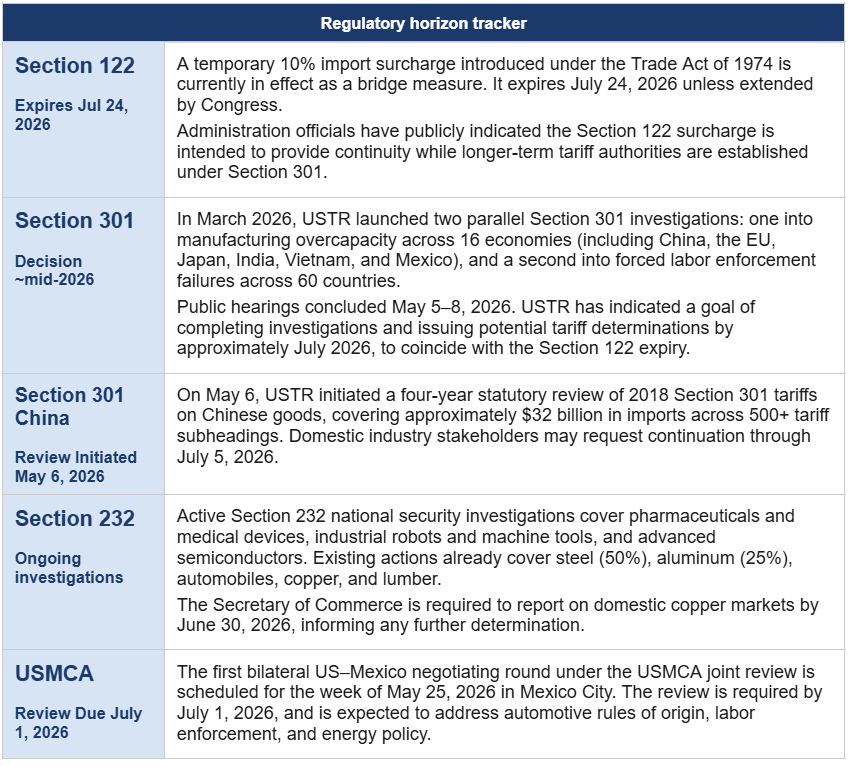
sourced from USTR, Congress.gov,
The combined effect of these mechanisms is that importers face a regulatory environment in transition. The IEEPA duties that were refunded may be partially or selectively replaced by Section 301 tariffs under different legal footing, though the scope, rates, and affected categories will depend on the outcome of ongoing investigations and any subsequent legal challenges.
What this means for trade teams
For enterprises managing significant import volumes, the immediate priority is filing IEEPA refund claims, recoverable cash with interest accruing. The parallel priority is stress-testing supply chains against Section 301 scenarios, particularly for goods sourced from countries under active investigation. The two timelines intersect: USTR has indicated tariff determinations could land around the same time the Section 122 bridge expires in late July 2026.
Companies that have not yet submitted comments in the Section 301 proceedings are in a weaker position to seek product exclusions if new tariffs are imposed. Legal experts note that participation in the administrative record is a prerequisite for preserving rights to challenge any tariffs that are ultimately enacted.
How SAIL helps
SAIL's AI-powered trade compliance workspace is built to handle exactly this kind of layered, fast-moving regulatory environment. SAIL helps trade teams identify IEEPA-eligible entries for refund, validate HTS classifications across portfolios, and model the duty impact of pending Section 301 and Section 232 scenarios before new rates take effect. As regulatory developments evolve, SAIL monitors rule changes in real time and recalculates duty positions automatically, so teams can act on new information rather than react to it after costs have already changed.
Ready to transform your Trade Compliance?
See how SAIL can help you classify faster and stay compliant.
Related Articles
Canada's Counter-Tariffs Are Now Live — and the U.S. Answered With Import Bans: Why US-Canada Trade Is Now a Three-Layer Exposure Problem
Canada's counter-tariffs are live and the U.S. answered with import bans. What's banned, what's taxed, and what trade teams need to check now.
Multi-Country Classification Is Now Live: What SAIL's US, Canada, EU and the UK Expansion Means for Trade Teams
"SAIL's classification now spans the US, Canada, EU and UK — as CBAM, steel tariffs, and de minimis rules all shift in 2026." (120 chars)
US-Canada Trade Tensions Escalate: What the New Tariffs Mean for Trade, Finance, and Supply Chain Teams
US-Canada tariffs hit 50% this week, with autos and steel set to double again in 2027. What trade, finance, and supply chain teams should do now.