The Duty Stack Doesn’t Lie: Using Tariff Layering to Detect Evasion
How HTS classification and full-stack duty analysis reveal what a declared origin cannot hide and why a new Executive Order makes this capability critical.

Chansam Kim
June 4, 2026
BREAKING: The U.S. administration signed Executive Order “Strengthening Customs Enforcement” on June 3, 2026. This post reflects its direct implications.
Duty evasion is, at its core, a math problem. The evader bets that the duty stack attached to a product’s true origin — its real HTS code, its actual country of manufacture, the full tower of applicable tariffs — is high enough to make falsification worthwhile. The enforcement question is simple: what does that duty stack actually look like? And does the number on the entry match it?
It often doesn’t. And when it doesn’t, that gap is a signal.
In 2025 and into 2026, U.S. authorities made tariff evasion one of their highest enforcement priorities. The Department of Justice formed a dedicated Trade Fraud Task Force in August 2025, joining forces with the Department of Homeland Security. On a single day in December 2025, DOJ announced three enforcement resolutions totaling over $100 million in customs duty evasion settlements.
Then, on June 3, 2026, yesterday, the U.S. administration signed an Executive Order titled “Strengthening Customs Enforcement.” The order mandates sweeping reforms to importer accountability, supply chain disclosure, misclassification enforcement, and audit mechanisms — all directed at exactly the kind of duty evasion that duty stack analysis is designed to detect.
This post explains how duty stacking works, why it is one of the most reliable signals of illegal transshipment, and what the new Executive Order demands of both enforcement agencies and compliant importers.
What Is a Duty Stack?
No import enters the United States under a single, simple tariff. It enters under a layered set of duties that stack on top of one another, each triggered by a different legal mechanism:
MFN (Most Favored Nation) Base Rate: The standard tariff applied to all WTO member countries. Determined entirely by the 10-digit HTS code.
Section 301 Tariffs: Retaliatory duties on Chinese-origin goods under the Trade Act of 1974, in full force since 2018 and intact in 2026. Rates range from 7.5% to 100%+ depending on product category. 178 product-specific exclusions are active through November 10, 2026 under the Trump–Xi trade agreement; a USTR four-year review initiated in May 2026 may allow certain lists to expire without industry requests for continuation.
Section 232 Tariffs: National security-based duties on metals, significantly restructured in April 2026. As of April 6, 2026: 50% on primary steel and aluminum articles (up from 25%/10%), 25% on derivative products substantially made of those metals, and 15% temporary rate on metal-intensive industrial equipment through December 2027. Copper was added to Section 232 coverage for the first time in 2025 at 25%. Applied to full customs value — no longer calculated on metal content alone.
Antidumping (AD) Duties: Product- and country-specific duties imposed when goods are found to be sold below fair market value. Rates can reach 200%+.
Countervailing Duties (CVD): Duties imposed to offset foreign government subsidies. Often layered on top of AD orders.
Section 122 Global Tariff (formerly IEEPA Reciprocal Tariffs): IEEPA-based reciprocal tariffs were struck down by the Supreme Court on February 20, 2026 (Learning Resources v. Trump, 6-3 ruling). In response, President Trump immediately imposed a replacement 10% global tariff on all countries under Section 122 of the Trade Act, effective February 24, 2026. This Section 122 tariff is currently being litigated. Steel and aluminum goods subject to Section 232 are excluded from the Section 122 global tariff to prevent double-stacking.
When a product is correctly classified and its true origin is declared, all applicable layers activate simultaneously. The sum of those layers is the duty stack. For a Chinese-made steel fastener today, that stack includes a 3.9% MFN rate, a 50% Section 232 steel tariff (restructured April 2026), a 25% Section 301 tariff, and an AD rate that can exceed 148%. Total exposure: well over 225%+ — on a single product line.
How Transshippers Exploit the Stack
Illegal transshipment is not fundamentally a logistics problem. It is a classification and origin problem. The transshipper's goal is to declare a product under a duty stack that is lower than the one its true characteristics would trigger. There are two primary levers:
1. Origin Substitution
Goods manufactured in China are routed through Vietnam, Malaysia, Mexico, or another intermediary country before entry into the United States. The declared country of origin shifts to the transit country, which may not be subject to Section 301 tariffs or AD/CVD orders. The HTS code itself may remain accurate, but the origin-dependent duty layers disappear from the declared stack.
In December 2025, DOJ settled a $54.4 million False Claims Act case against Ceratizit USA, which had allegedly declared Chinese-origin tungsten carbide cutting tools as manufactured in Taiwan, specifically to avoid Section 301 duties. The HTS code was likely correct. The origin was not. The duty gap between the two was the fraud.
2. Misclassification to Shift Codes
The second lever is changing the declared HTS code itself. If a product falls under an AD/CVD order or a high Section 301 rate, a bad actor may declare it under a related but unaffected code. Steel wire declared as steel rod. Cargo vans declared as passenger vehicles. Industrial components declared as consumer goods.
Ford’s $365 million settlement illustrates this precisely: Transit Connect vans were imported as passenger vehicles (duty rate 2.5%) rather than the correct cargo vehicle classification (duty rate 25%). One digit different in the HTS code. Ten times the duty rate.
The Detection Logic: What the Stack Reveals
Here is why duty stack analysis is such a powerful detection tool: the correct duty stack for a product is computable independently of what the importer declares. If you can derive the accurate HTS code from the product’s own attributes — its material composition, dimensions, intended use, bill of materials— you can calculate what its duty stack should be. Then you compare it to what was declared.
The gap between the computed stack and the declared stack is the anomaly signal.
Consider a simplified example: Chinese-origin steel fasteners routed through Vietnam, entered under a Vietnamese-origin declaration.
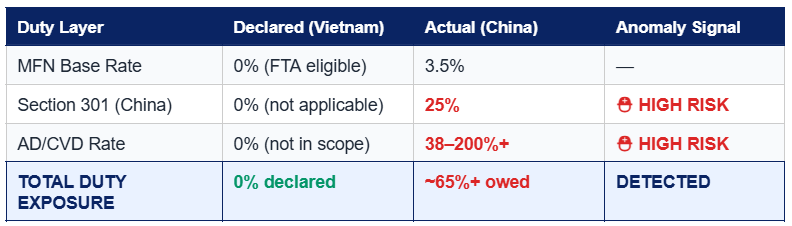
No human reviewing a single entry line would catch this. But an AI system that independently classifies the product from its technical specifications and then computes the full expected duty stack surfaces it immediately. The declared total duty exposure is zero. The computed total is 65%+. That is not a rounding error. It is a red flag.
Why Accurate HTS Classification Is the Foundation
None of this works without accurate, independent classification. The entire detection logic depends on the ability to derive the correct HTS code from the product’s own characteristics without trusting what the importer declared.
This is harder than it sounds. The Harmonized Tariff Schedule of the United States contains thousands of 10-digit codes, organized by chapter, heading, and subheading. Correct classification requires applying the General Rules of Interpretation, consulting the WCO Explanatory Notes, checking CBP CROSS rulings for similar products, and resolving ambiguities based on the product’s primary function, material, and intended use.
For complex industrial products — multi-component assemblies, chemical formulations, BOM-intensive manufactured goods — this is a task that previously required a licensed customs broker or trade attorney. It was not scalable to millions of entry lines.
Intelligence classification engines change that calculus. By ingesting product DNA — technical datasheets, bills of materials, safety data sheets, product images, purchase orders — and cross-referencing that data against the tariff schedule, legal rulings, and regulatory notes, modern classification systems can produce defensible HTS determinations at scale. With explainable reasoning. With cited legal authority. And independently of what the importer declared.
That independence is everything. A system that simply validates a declared code is not a detection tool. A system that derives the correct code from first principles — and then compares it to the declaration — is.
The Enforcement Landscape Is Accelerating
The urgency of this capability is not theoretical. The enforcement environment has shifted materially.
In August 2025, DOJ formally launched the Trade Fraud Task Force, a cross-agency operation with DHS focused specifically on tariff evasion. In the same month, customs enforcement announced a $400 million duty evasion action targeting transshipment of Chinese-made goods through Southeast Asia. Whistleblower complaints about duty evasion surged 160% year-over-year between March and May 2025. By fiscal year 2025, settlements and judgments under the False Claims Act totaled over $6.8 billion.
On December 18, 2025 — a single day — DOJ announced three separate enforcement resolutions:
Ceratizit USA: $54.4 million settlement for transshipping Chinese tungsten carbide cutting tools through Taiwan to evade Section 301 duties.
Wanxiang America: $53 million settlement for misclassifying Chinese automotive components to avoid antidumping duties.
A third coordinated action, bringing the single-day total past $100 million in combined duty evasion resolutions.
Enforcement agencies stated explicitly that they are using data analytics and intelligence tools to detect evasion patterns — moving from reactive investigation to proactive, data-driven targeting. The same underlying methodology — independent classification, full duty stack computation, anomaly detection across large datasets — is now operating on both sides of the enforcement equation.
Note: IEEPA-based reciprocal tariffs were struck down by the Supreme Court on February 20, 2026. The U.S. administration replaced them the same day with a 10% global tariff under Section 122, currently in effect and under litigation.
NEW: Executive Order "Strengthening Customs Enforcement" — Signed June 3, 2026
Effective immediately: This Executive Order directly targets misclassification, undervaluation, and illegal transshipment as federal enforcement priorities. Importers and customs brokers face tighter disclosure mandates, higher bond requirements, and minimum penalty floors. Compliance programs built on manual processes or broker-dependent classification are now structurally exposed.
The Executive Order "Strengthening Customs Enforcement" represents the most comprehensive customs reform directive in years. Its stated purpose captures the enforcement agenda precisely: "Customs enforcement is essential to the national security, foreign policy, and economy of the United States. Effective customs enforcement prevents the importation of unlawful and dangerous goods; ensures importers of record are correctly identified and accountable for duties owed."
The order identifies the core failure modes it is designed to fix: "Systemic inefficiencies, loopholes, insufficient enforcement mechanisms, and outdated processes have created opportunities for malign actors to evade Federal law. Examples of noncompliance include undervaluing imports, withholding critical information about IORs and the goods being imported, and avoiding payment of duties through various arrangements and schemes."
Every phrase in that statement describes a scenario that duty stack analysis is built to detect. Here are the provisions with the most direct operational implications:
Section 3 — Heightened Supply Chain Disclosure Requirements
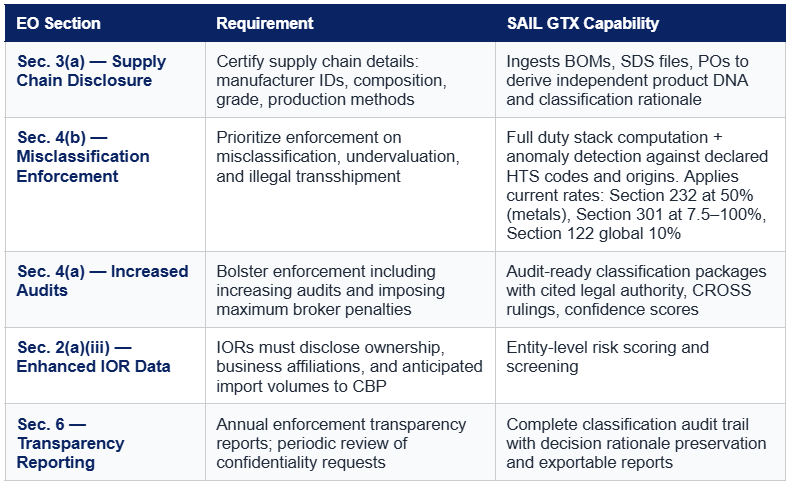
The EO directs CBP to require importers to certify compliance with supply chain requirements and disclose detailed information about the imported good's "supply chain and production methods, such as the manufacturer's product identifier (e.g., model or style number) or key specifications (e.g., composition, grade, or size)."
This is precisely the product DNA that an independent classification engine requires to derive an accurate HTS code. When an importer can now be required to certify product specifications at entry, those specifications become the ground truth against which a declared HTS code can be validated. If the certified composition doesn't match the declared code, the anomaly is documentable.
Section 4(b) — Enforcement Priority: Misclassification and Illegal Transshipment
This section directs the Secretary of Homeland Security and the Attorney General to "prioritize the enforcement of Federal law relating to importations involving products produced by forced labor, and importations involving misclassification, undervaluation, and illegal transshipment." It explicitly references the Enforce and Protect Act as an investigative vehicle.
Misclassification and illegal transshipment are named together for a reason: they are operationally linked. Transshipment almost always involves either a reclassification or an origin misrepresentation that produces an incorrect duty stack. The enforcement tool to detect both is the same: independent classification and duty stack comparison.
Section 4(a) — Increased Audits and Broker Accountability
The EO directs CBP to increase audits and impose maximum penalties on brokers who "fail to conduct due diligence, repeatedly represent noncompliant clients, or fail to cooperate in a timely manner." It also establishes a minimum penalty floor of not less than 50 percent of the assessed penalty, with no mitigation for repeat offenders.
For importers whose classification programs rely on broker judgment without independent validation, this provision represents material new exposure. The audit-readiness standard has just been raised. A classification that cannot be defended with cited legal authority, product-level documentation, and an explainable audit trail is no longer a defensible classification.
Section 2(a)(iii) — Enhanced Importer of Record Data
IORs will be required to provide CBP with expanded data including anticipated import volumes, beneficial ownership disclosures, and business affiliation disclosures. This provision targets shell company structures and sham transactions used to obscure Chinese-origin goods.
Entity-level beneficial ownership data, cross-referenced against shipment patterns and HTS classification anomalies, is one of the most powerful signals available for detecting coordinated transshipment networks. When an IOR's ownership traces to a Chinese manufacturer — while its declared products carry Vietnamese-origin classifications and impossibly low duty stacks — the convergence of signals is unambiguous.
The table below maps specific EO provisions to the SAIL GTX capabilities they implicate:
What This Means for Compliant Importers
Compliance teams at legitimate importers face a compounding pressure. The risk is not only for bad actors — it also falls on companies whose documentation is thin, whose tariff classifications have not been reviewed since 2022, and whose suppliers may have been quietly transshipping through third countries without the importer’s knowledge.
False Claims Act liability can attach to importers who "knew or should have known" their entries were inaccurate. That standard is increasingly being tested in court. With a 10-year statute of limitations under the FCA, prior-period exposure is material. The new EO's minimum penalty floors and elimination of mitigation for repeat offenders remove the safety valve that once softened enforcement outcomes for borderline cases.
The implication is direct: compliant importers need the same capability that enforcement agencies are deploying. Independent classification. Full duty stack computation. Anomaly detection against declared entries. Supply chain disclosure documentation that can be certified at entry. Not to evade, but to audit their own supply chain before someone else does.
How SAIL GTX Operationalizes Duty Stack Analysis
SAIL GTX's platform is built specifically around this architecture. The classification engine ingests product DNA — BOMs, technical datasheets, SDS files, purchase orders, product images — and independently derives the correct HTS code with legal-grade reasoning, citing General Rules of Interpretation, WCO Explanatory Notes, and CBP CROSS rulings.
From that independently-derived classification, the platform computes the full duty stack: MFN base rate, Section 301 applicability, Section 232 exposure (now 50% on primary metals following the April 2026 restructure), AD/CVD order scope, and Section 122 global tariff applicability — simultaneously and automatically. Every layer is calculated based on the product's actual characteristics and declared origin, not taken at face value from the entry.
The result is a computed duty exposure that can be compared directly to the declared duty. Discrepancies are flagged, ranked by magnitude, and made available for review. The entire determination — every classification decision, every tariff layer, every anomaly signal — is preserved in a full audit trail with source citations.
For compliance teams, this means supply chain self-audit capability that now aligns directly with the EO's disclosure and certification requirements. For enforcement contexts, it means the ability to process large shipment datasets and surface the entries with the highest anomaly scores for further review.
The duty stack doesn't lie. With the right classification engine, and with the new disclosure mandates giving enforcement agencies more product-level data than ever before, the question is simply who processes that data first.
Ready to transform your Trade Compliance?
See how SAIL can help you classify faster and stay compliant.
Related Articles
Canada's Counter-Tariffs Are Now Live — and the U.S. Answered With Import Bans: Why US-Canada Trade Is Now a Three-Layer Exposure Problem
Canada's counter-tariffs are live and the U.S. answered with import bans. What's banned, what's taxed, and what trade teams need to check now.
Multi-Country Classification Is Now Live: What SAIL's US, Canada, EU and the UK Expansion Means for Trade Teams
"SAIL's classification now spans the US, Canada, EU and UK — as CBAM, steel tariffs, and de minimis rules all shift in 2026." (120 chars)
US-Canada Trade Tensions Escalate: What the New Tariffs Mean for Trade, Finance, and Supply Chain Teams
US-Canada tariffs hit 50% this week, with autos and steel set to double again in 2027. What trade, finance, and supply chain teams should do now.