The Supreme Court Struck Down IEEPA Tariffs.
The Supreme Court struck down IEEPA tariffs, but Section 232 and 301 remain. A new 10% Section 122 tariff reshapes enterprise duty exposure.

Chansam Kim
February 24, 2026
Co-Authored with Drew Adler, Product Marketing
What Happened
On February 20, 2026, the U.S. Supreme Court ruled 6-3 that the International Emergency Economic Powers Act (IEEPA) does not authorize the President to impose tariffs. This invalidates the broad reciprocal tariff framework that affected nearly every U.S. trading partner throughout 2025. Within hours, President Trump issued a proclamation under Section 122 of the Trade Act of 1974 imposing a 10% global tariff, then raised it to 15% — the statutory maximum — on February 21. Section 122 tariffs took effect at 10% on February 24, 2026.
1. What Is Still in Effect
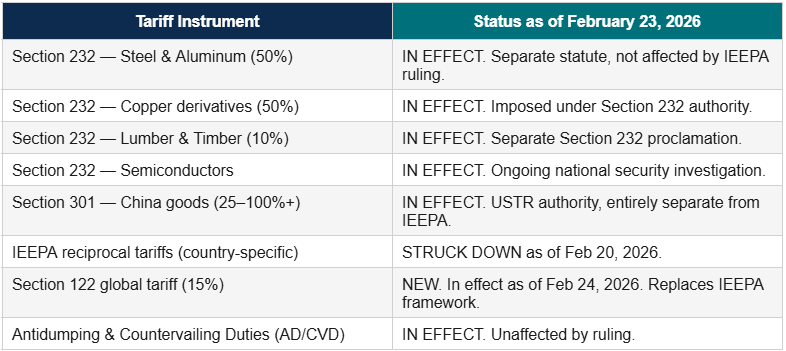
The ruling creates significant confusion for compliance teams because the tariff environment did not simply reset to pre-2025 conditions. A large portion of the tariff burden enterprise importers have been managing throughout 2025 remains fully in force under separate legal authorities that were not touched by the IEEPA ruling.
The Critical Point Most Teams Are Missing
For Chemicals, Energy, and Industrial Manufacturing importers, the tariffs that represent the largest duty exposure — Section 232 on steel, aluminum, copper, and lumber, and Section 301 on Chinese-origin goods — are completely unchanged by the IEEPA ruling. The duty reduction from removing IEEPA reciprocal tariffs is real, but for industrial importers it is likely a fraction of total tariff burden. The work of classification accuracy, FTA optimization, and audit readiness is as urgent as it was before February 20.
2. The Section 122 Replacement and What It Changes
Section 122 of the Trade Act of 1974 grants the President authority to impose temporary import surcharges when there is a large and serious balance-of-payments deficit. It is a narrower authority than IEEPA but does not require a formal national security emergency declaration. The initial proclamation set the rate at 10%, and Trump raised it to 15% — the statutory maximum — via Truth Social on February 21. The 10-15% global tariff is broadly similar in application to the prior IEEPA baseline — with important differences that enterprise compliance teams need to understand immediately.
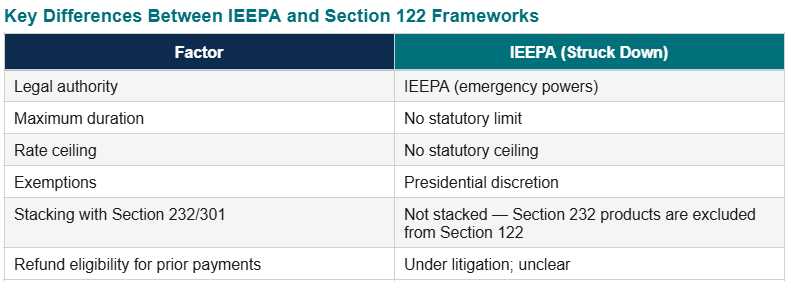
A critical difference from the IEEPA framework: Section 122 explicitly excludes products already subject to Section 232 tariffs. Steel, aluminum, copper, lumber, automobiles, and other Section 232-covered goods are exempt from the Section 122 surcharge entirely. For industrial importers whose largest tariff exposure is in Section 232-covered materials, the Section 122 tariff may not apply to those products at all. For derivative goods that are only partially subject to Section 232 (i.e., where the tariff applies only to the steel or aluminum content), the 10% Section 122 surcharge applies to the non-Section-232 portion. If your team has been using duty calculations built on the 2025 IEEPA tariff structure, landed cost models need to be reviewed against the new Section 122 rules before your next shipment — particularly for any product that previously stacked IEEPA on top of Section 232.
The February 20 proclamation established a 10% global import surcharge, which took effect on February 24, 2026.
3. The IEEPA Refund Question
One of the most actively discussed questions following the ruling is whether importers can claim refunds for IEEPA duties already paid. The short answer is: unclear, and likely to remain so for months. The Supreme Court ruling addressed the legality of the tariffs but did not resolve the question of refunds. That question will work through lower courts separately.
What Enterprise Importers Should Do Now on Refunds
Document every IEEPA duty payment made from the effective date of each relevant executive order through February 20, 2026. This includes the reciprocal tariff payments on goods from affected trading partners. If you do not have a complete, SKU-level record of duties paid by tariff authority, now is the time to build one — because if refund eligibility is confirmed by the courts, the filing window will be time-limited and the documentation requirements will be substantial. Teams relying on broker records alone are at risk of being unable to substantiate a refund claim.
4. Why This Ruling Is an Audit Trigger, Not a Relief Signal
Trade compliance leaders at enterprise industrial companies should treat the IEEPA ruling as a compliance review trigger — not a reason to stand down. There are three specific reasons why CBP enforcement activity is likely to accelerate in the near term, not slow down.
Reason 1: Tariff Reclassification Creates Classification Confusion
When tariff instruments change rapidly — IEEPA out, Section 122 in, Section 232-covered goods now exempt from the surcharge — classification errors follow. Products your team previously classified under the IEEPA framework may now be exempt from Section 122 if they are Section 232-covered, or subject to the new 10% surcharge if they are not. Getting this wrong in either direction — applying Section 122 where it doesn’t apply, or omitting it where it does — creates a compliance flag. CBP’s algorithmic targeting systems flag anomalies: if your classification behavior changes significantly in a short period, that generates a flag. If it doesn’t change when it should, that also generates a flag.
Reason 2: CBP’s Enforcement Posture Is Not Changing
The CBP enforcement buildup of 2025 — $310M in duties identified in March 2025 alone, 348 audits completed through mid-FY2025 on pace to match or exceed the five-year average of 438, $4.1B in new enforcement funding — was built on the Section 232 and Section 301 framework, not IEEPA. The enforcement infrastructure being built is designed for a long-running tariff environment, not a temporary emergency. The IEEPA ruling does not change CBP’s mandate, funding, or targeting technology.
Reason 3: The Complexity Itself Creates Exposure
The most common source of CBP audit triggers is not intentional evasion — it is classification errors made during periods of high regulatory complexity. Transitions between tariff frameworks are exactly those periods. The teams most at risk are those relying on broker-led classification, manual spreadsheet tracking, or infrequent catalog reviews — because by the time the error is caught, it may cover multiple shipments across multiple quarters.
5. The Immediate Action List for Trade Compliance Directors
The following six steps represent the minimum immediate response for enterprise compliance teams in Chemicals, Energy, and Industrial Manufacturing. They should be completed in parallel, not sequentially.
Audit your tariff authority mapping. For every active product category, verify which tariff instruments now apply. Any product previously subject to IEEPA reciprocal tariffs needs a new duty calculation under Section 122 rules. Products subject only to Section 232/301 are unchanged but should be confirmed.
Recalculate landed cost for active shipments. Any shipment in transit or in planning that was priced against the IEEPA tariff structure needs to be recalculated. Key question for each product: is it covered by Section 232 (exempt from Section 122) or only by Section 301/other duties (subject to the new 15% Section 122 surcharge)? The answer determines your actual landed cost and may be materially different from your prior model.
Document IEEPA duty payments for potential refund eligibility. Pull together SKU-level records of all duties paid under each IEEPA executive order. Even if the refund question is unresolved, having the documentation ready positions you to act quickly if a filing window opens.
Review your FTA eligibility under the new framework. Some products that did not previously qualify for FTA treatment — because the stacked IEEPA rate made FTA analysis less urgent — may now represent meaningful savings under the Section 122 structure. Additionally, if your Section 232-covered products are now exempt from Section 122 entirely, that changes the FTA calculus for your overall portfolio. This is the moment to run a systematic FTA pass.
Alert your broker and verify their classification updates. Do not assume your customs broker has already updated their systems to reflect Section 122. Confirm explicitly, in writing, that entries filed on or after February 24 are being processed under the correct authority. Specifically verify how they are treating Section 232-covered goods (which are exempt from Section 122) versus non-Section-232 goods (which are subject to the 15% surcharge).
Brief your CFO and General Counsel. The combination of tariff authority change, potential refund litigation, and ongoing CBP enforcement buildup represents a material financial and legal risk conversation that should not stay in the compliance function. The refund question alone may involve significant recoverable duties.
Sources & Citations
U.S. Supreme Court, V.O.S.I. v. Trump (6-3 decision, February 20, 2026). Ruling that IEEPA does not authorize the President to impose tariffs. Sourced via U.S. Court of International Trade case filings and Supreme Court slip opinion. — supremecourt.gov
White House, Presidential Proclamation Under Section 122 of the Trade Act of 1974, February 20, 2026. Establishes initial 10% global import surcharge effective February 24, 2026. — whitehouse.gov
White House Proclamation 10895 (steel, 50%) and Proclamation 10896 (aluminum, 50%), effective March 12, 2025. Federal Register Vol. 90. CBP CSMS — federalregister.gov
White House Proclamation on copper (50% Section 232 tariff, effective August 2025). Rate sourced via Ropes & Gray trade alert and Federal Register filing. — federalregister.gov
White House Proclamation on softwood lumber and timber (10% ad valorem Section 232 tariff, effective October 14, 2025). Federal Register Vol. 90. Rate sourced via Federal Register. — federalregister.gov
Don’t Navigate This Alone
SAIL GTX gives enterprise trade compliance teams real-time tariff monitoring, automated reclassification alerts, and audit-ready documentation — so you know your exposure before CBP does.
We’re offering a free Tariff Exposure Report for enterprise importers in Chemicals, Energy, and Industrial Manufacturing — up to 500 SKUs analyzed, results within 5 business days.
sailgtx.com | info@sailgtx.com
Ready to transform your Trade Compliance?
See how SAIL can help you classify faster and stay compliant.
Related Articles
Canada's Counter-Tariffs Are Now Live — and the U.S. Answered With Import Bans: Why US-Canada Trade Is Now a Three-Layer Exposure Problem
Canada's counter-tariffs are live and the U.S. answered with import bans. What's banned, what's taxed, and what trade teams need to check now.
Multi-Country Classification Is Now Live: What SAIL's US, Canada, EU and the UK Expansion Means for Trade Teams
"SAIL's classification now spans the US, Canada, EU and UK — as CBAM, steel tariffs, and de minimis rules all shift in 2026." (120 chars)
US-Canada Trade Tensions Escalate: What the New Tariffs Mean for Trade, Finance, and Supply Chain Teams
US-Canada tariffs hit 50% this week, with autos and steel set to double again in 2027. What trade, finance, and supply chain teams should do now.