Beyond the Shipping Label: Why HS and HTS Codes Are the New CFO Priority in 2026
Discover why HS and HTS codes are critical for COGS and margin protection in 2026. Learn to navigate CBP audits and leverage AI for trade compliance.

Chansam Kim
December 31, 2025
Beyond the Shipping Label: Why HS and HTS Codes Are the New CFO Priority in 2026
In the global trade landscape of 2025, physical supply chains are striving for fluidity, but the regulatory frameworks governing them have become more rigid than ever. At the heart of this complexity are HS and HTS codes — the numerical nomenclature that serves as the financial DNA of every product in international commerce.
For the modern global enterprise, these codes are no longer just administrative markers; they are strategic variables that dictate your Cost of Goods Sold (COGS), the integrity of your financial reporting, and your legal standing during a customs audit.
The Taxonomy of Trade: HS vs. HTS Codes
To navigate the financial implications of trade, leadership must distinguish between the global foundation and national adaptations.
1. The Harmonized System (HS) Code
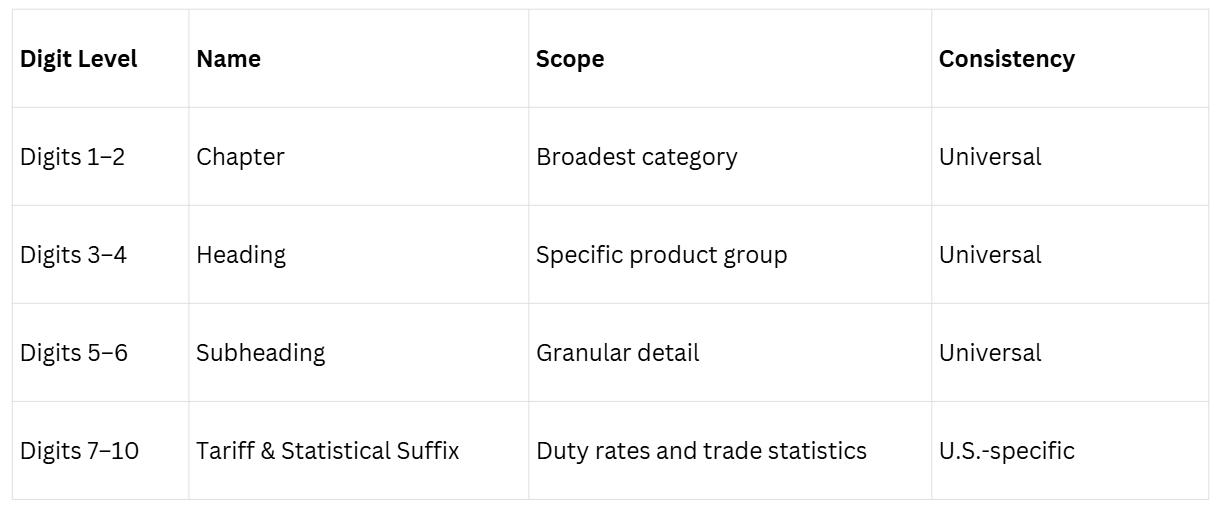
The HS code is a standardized six-digit root developed by the World Customs Organization (WCO) and used by over 200 countries. It ensures that a product is identified uniformly across the globe, from the first six digits of its classification.
2. The Harmonized Tariff Schedule (HTS) Code
While the HS code provides the global foundation, individual nations append extra digits, usually creating a 10-digit code, to address domestic duty rates and statistical needs. In the U.S., this is the HTSUS.
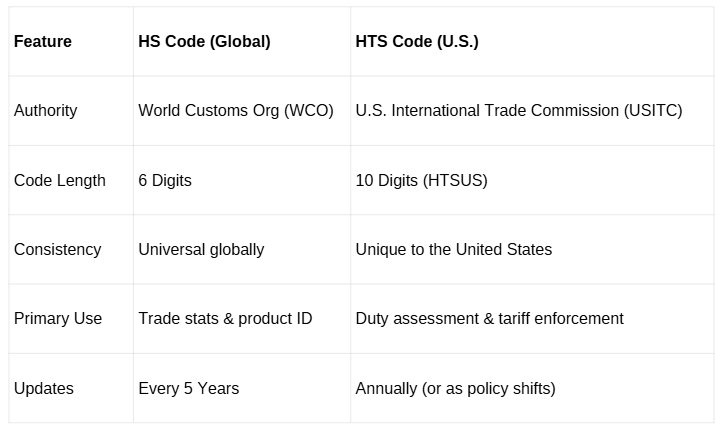
The Strategic Risk: Relying on a classification from a foreign supplier is a common mistake. Under the legal doctrine of "reasonable care," the U.S. importer of record is legally responsible for verifying that the 10-digit HTSUS code is accurate under U.S. law, as these final digits determine the specific duty rates and regulatory controls applied at the border.
The Financial Architecture: Margin Protection and COGS
From a finance perspective, the HTS code is the primary mechanism through which your "tariff stack" is calculated. In 2025, where over 56% of CFOs are focused on enterprise-wide cost optimization, the precision of these codes is critical for protecting gross margins.
Landed Cost Modeling
The HTS code determines the basic duty rate and triggers supplemental duties like Section 301 (Chinese-origin goods), Section 232 (steel/aluminum), and Anti-dumping duties (AD/CVD). Misclassifying a product by a single digit can shift its duty status from 0% to over 25%, creating a massive, unforecasted impact on COGS.
To calculate the true landed cost, finance teams must account for the total rate


MFN (Most-Favored-Nation) is the baseline duty rate under the U.S. Harmonized Tariff Schedule, while AD/CVD (Anti-Dumping and Countervailing Duties) are case-specific penalties imposed on certain products or exporters to offset unfair pricing or foreign government subsidies.
As seen in the 2025 automotive sector, where tariffs on parts rose to 25%, failure to model these costs before a shipment arrives can reduce gross margins from 41% to as low as 29%.
Regulatory Scrutiny: The 2025 Enforcement Surge
The regulatory environment has shifted from traditional sampling to data-driven enforcement. U.S. Customs and Border Protection (CBP) completed 200 audits in the first four months of 2025 alone, recovering $134 million in duties—already surpassing the entire previous year's collections.
The Audit Trail: CF-28 and CF-29
CBP uses advanced analytics to identify classification patterns that suggest duty avoidance. If they find a discrepancy, they issue:
CBP Form 28 (Request for Information): An inquiry demanding detailed product specs within 30 days.
CBP Form 29 (Notice of Action): A binding notification that CBP has reclassified your goods and assessed additional duties.
The Cost of Non-Compliance
The stakes have been elevated by the False Claims Act (FCA). In the 2025, an importer was hit with a $26 million judgment for misclassifying steel products to evade antidumping duties. The jury's $8 million finding in underpaid duties was trebled (tripled) under the FCA.
The AI Transformation: Scaling Trade Intelligence
Manual classification, averaging 45 minutes per product, is no longer a viable strategy for enterprises managing thousands of SKUs. Traditional manual workflows typically only cover about 15% of a product catalog through sampling, leaving 85% of the business exposed to audit risk.
Modern trade compliance platforms, like SAIL, are replacing these manual scrambles with Agentic AI.
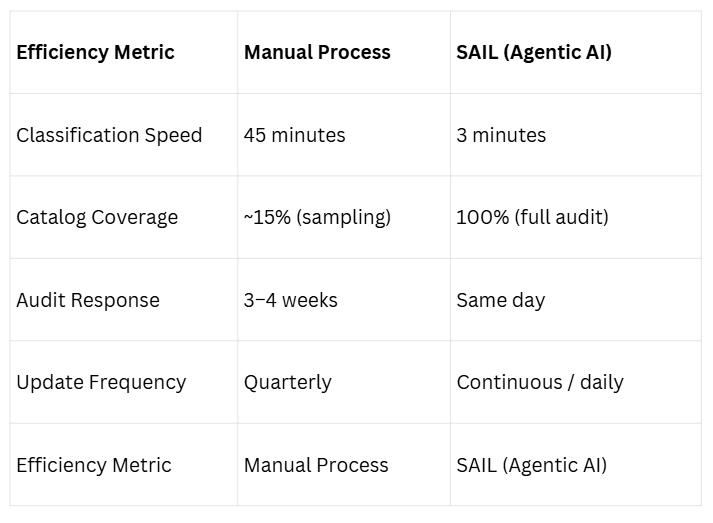
Unlike "black box" AI, SAIL provides Classification Reasoning Chains—full legal logic and evidence chains explaining why a code was chosen.10 This provides "litigation-grade" evidence that satisfies both internal auditors and customs officials.
Conclusion: Compliance as a Competitive Advantage
Mastering HS and HTS classification is no longer a back-office logistics task; it is a core business requirement. By adopting AI-driven trade intelligence, firms can protect their gross margins from "tariff stack" volatility and ensure they remain audit-ready in an era of heightened enforcement.
The goal for 2026 is clear: Move from the manual scramble of spreadsheets to an automated, defensible environment where trade compliance is a strategic driver of growth and profitability.
Tagged with
Ready to transform your Trade Compliance?
See how SAIL can help you classify faster and stay compliant.
Related Articles
Canada's Counter-Tariffs Are Now Live — and the U.S. Answered With Import Bans: Why US-Canada Trade Is Now a Three-Layer Exposure Problem
Canada's counter-tariffs are live and the U.S. answered with import bans. What's banned, what's taxed, and what trade teams need to check now.
Multi-Country Classification Is Now Live: What SAIL's US, Canada, EU and the UK Expansion Means for Trade Teams
"SAIL's classification now spans the US, Canada, EU and UK — as CBAM, steel tariffs, and de minimis rules all shift in 2026." (120 chars)
US-Canada Trade Tensions Escalate: What the New Tariffs Mean for Trade, Finance, and Supply Chain Teams
US-Canada tariffs hit 50% this week, with autos and steel set to double again in 2027. What trade, finance, and supply chain teams should do now.