The Petro-Protectorate Paradigm: Trade Compliance in Post-Maduro Venezuela
How Venezuela’s U.S.-managed transition reshapes energy infrastructure, sanctions, and HTS compliance and why AI-native trade operations are now mission-critical.

Chansam Kim
January 5, 2026
The Petro-Protectorate Paradigm: Strategic Trade Compliance and Infrastructure Revitalization in Post-Maduro Venezuela
The geopolitical architecture of the Western Hemisphere underwent a terminal transformation on January 3, 2026, with the execution of Operation Absolute Resolve, a high-intensity military action resulting in the capture of President Nicolás Maduro and his wife, Cilia Flores, in Caracas. This event represents a rupture in traditional diplomatic paradigms, transitioning Venezuela from a sanctioned pariah state into a "Petro-Protectorate" under the temporary administration of the United States. For global energy enterprises, the sudden accessibility of the world’s largest proven oil reserves—estimated at 303 billion barrels—presents a historic opportunity, yet it simultaneously introduces a period of unprecedented regulatory volatility, logistical complexity, and compliance risk. The success of corporate re-entry and the proposed "Marshall Plan" for Venezuelan oil infrastructure hinges not merely on engineering capacity but on the ability of trade compliance teams to navigate a shifting labyrinth of Harmonized Tariff Schedule (HTS) classifications, Office of Foreign Assets Control (OFAC) mandates, and the intricate legal mechanics of "reimbursement" frameworks.
Geopolitical Rupture and the Monroe Doctrine Redefined
The military intervention by the United States, framed within the operational context of narcotrafficking, has effectively rewritten the rules of engagement in South America. President Donald Trump’s assertion that the United States will "run the country" until a "safe, proper and judicious transition" occurs signals a move toward a transactional hegemonic model. This framework, formally articulated as a "Trump Corollary" to the Monroe Doctrine in late 2025, prioritizes the denial of hemispheric access to non-regional competitors such as China and Russia while securing vital energy commodities for the United States and its allies. The ideological shift from isolationism to selective aggression creates a unique operating environment where sovereign integrity is subordinated to the protection of American interests and the stabilization of global energy prices.
The current political structure in Caracas is characterized by extreme fluidity. While the Venezuelan high court ordered Vice President Delcy Rodríguez to assume the role of interim president, the underlying Chavismo system remains largely entrenched within the military and bureaucracy. Rodríguez’s shift from defiant rhetoric to a conciliatory "agenda of cooperation" underscores the fragility of the current administration and its total dependence on U.S. recognition. However, the U.S. demand for "total access" to infrastructure—from oil fields to basic road networks—ensures that the risk premium for foreign enterprises remains elevated. Every shipment of equipment and every infrastructure contract must be scrutinized against the potential for nationalist backlash or international legal disputes regarding the national assets.
The Infrastructure Deficit: Reclaiming the Largest Reserves
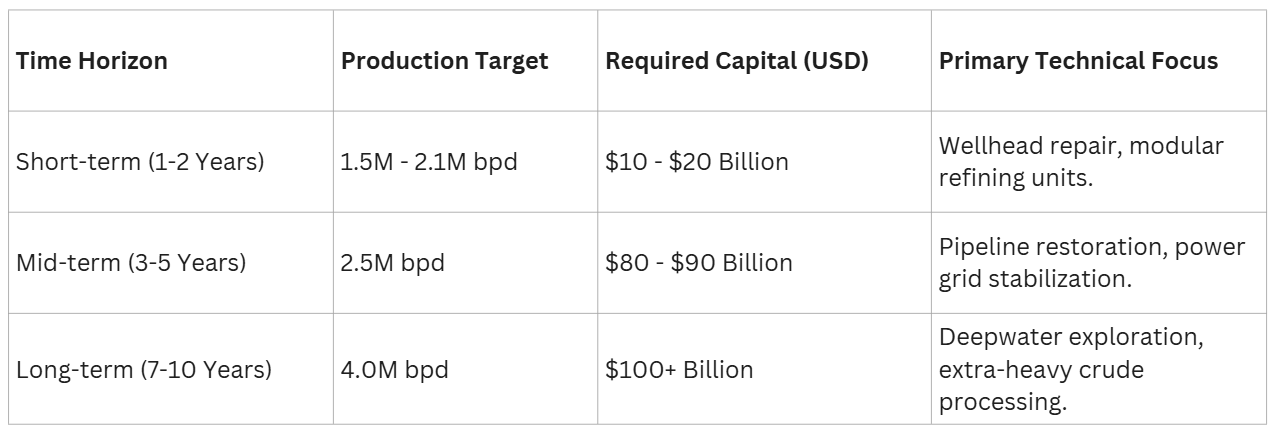
The scale of the reconstruction effort required to return Venezuela to its peak production levels is staggering. While the country sat on 17% of the world’s global oil reserves as of 2025, production had plummeted from 3.5 million barrels per day (bpd) in the late 1990s to approximately 800,000–1.1 million bpd by the time of the Maduro capture. This decline was the result of decades of mismanagement, the nationalization of assets in 2007, and the biting effects of international sanctions. Experts estimate that increasing production by just 500,000 to 1 million bpd will require an immediate investment of over $10 billion, while returning to historical levels will necessitate $100 billion and a decade of sustained reconstruction.
The physical state of the infrastructure is one of terminal decay. Venezuelan oil facilities are dilapidated, the power system is fragile, and operational management frequently relies on paper records rather than digital oversight. This necessitates a holistic revitalization strategy that includes not only upstream drilling but also a massive digital transformation and the rebuilding of the domestic power grid to support extraction. U.S. President Trump has indicated that U.S. oil companies will be "reimbursed" for these costs through the "money coming out of the ground," effectively creating a creditor-controlled extraction model.
Investment and Production Projections for the Petro-Protectorate
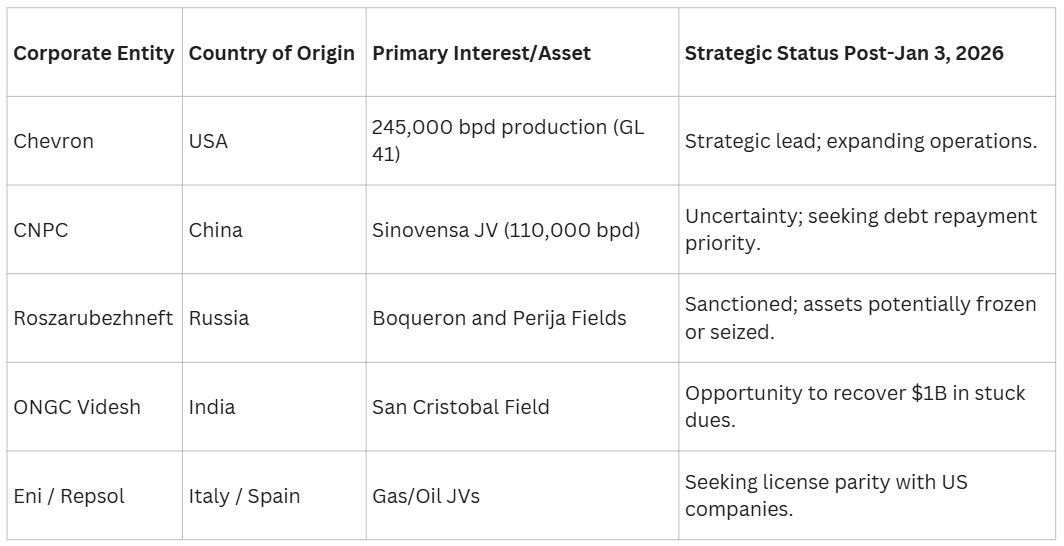
Exposure of Key Global Players in the Venezuelan Energy Sector
The Compliance Bottleneck: HTS Classification in the Petro-Protectorate
For enterprises mobilized to rebuild Venezuela, the most significant barrier to entry is the complexity of trade compliance. The importation of thousands of SKUs—ranging from modular refineries and high-pressure pumps to microgrid energy storage systems—requires precise Harmonized Tariff Schedule (HTS) classification to avoid delays, fines, and audit exposure.
Technical Nuance in Chapter 84 and 85
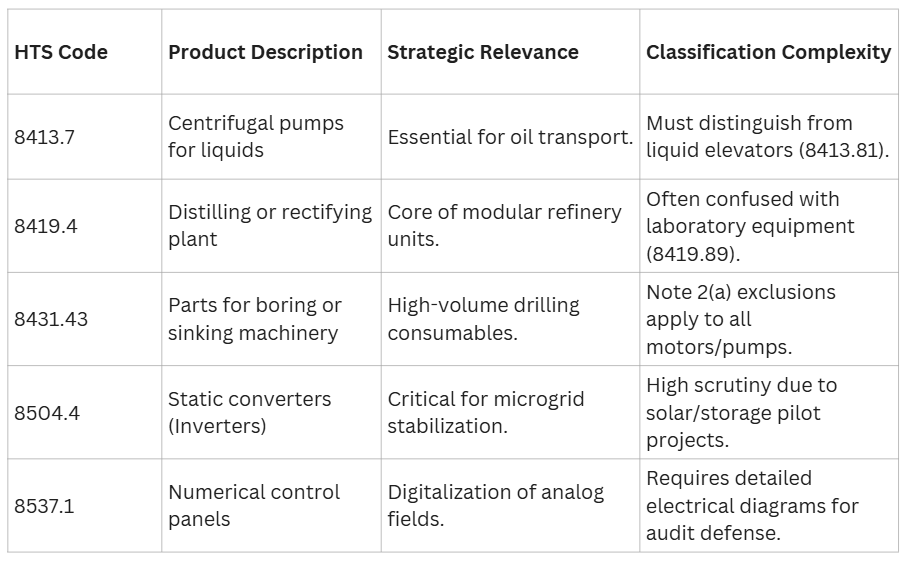
The majority of oil and gas equipment is classified under Section XVI of the HTS, specifically Chapters 84 (mechanical appliances) and 85 (electrical equipment). These chapters are governed by strict Section and Chapter notes that often contradict common sense. For instance, Section XVI Note 2(a) dictates that "parts" of machines that are themselves headings in Chapter 84 or 85 must be classified under their own headings. This means a centrifugal pump imported as a spare part for an oil rig is classified under 8413 (Pumps) rather than 8431 (Parts for boring machinery), a distinction that can significantly alter duty rates and PGA (Partner Government Agency) requirements.
Manual classification of such complex equipment typically requires 45 minutes per product, as compliance officers must review technical specifications, material compositions, and historical CROSS (Customs Rulings Online Search System) rulings. In the context of a rapid military-led reconstruction effort, this manual approach creates a critical bottleneck, often resulting in only 15% of a catalog being accurately classified before shipment.
Key HTS Classifications for Energy Infrastructure Reconstruction
Sanctions and Legal Sovereignty: The General License Labyrinth
The transition to a U.S.-run Venezuela has not resulted in the immediate removal of all sanctions. Instead, the administration has maintained the oil embargo in "full effect" while utilizing a sophisticated "two-tier" market structure governed by selective OFAC General Licenses. This allows the U.S. government to maintain economic pressure on the remaining elements of the Chavista regime while permitting compliant commercial activity by authorized U.S. firms.
The Evolution of General License 41 and 41A
Prior to the Maduro capture, General License 41 (GL 41) allowed Chevron to engage in limited production and export of petroleum products to the U.S. as a concession for democratic reform. Following the January 3 intervention, the Trump administration issued GL 41A, which authorized a wind-down of certain Biden-era concessions while simultaneously preparing for a more robust framework under the new "Petro-Protectorate" rules. For other energy majors, the path to re-entry involves pursuing "specific licenses" that mirror the Chevron framework, requiring exhaustive due diligence to ensure that no funds are diverted to "blocked parties" or sanctioned entities within the Venezuelan military.
Compliance teams must also contend with the "Shadow Fleet"—a network of vessels used by the previous regime and its allies in Iran and China to bypass sanctions. As of late 2025, there was a 45% increase in dark fleet activity linked to Venezuela. The 2026 reconstruction effort requires a "clean oil" verification process that can distinguish between legally produced protectorate crude and black-market flows.
Sail GTX: AI-Native Defense for the Energy Sector
In this high-stakes environment, SAIL GTX provides the technological infrastructure necessary for enterprises to move at the speed of the military-led "Marshall Plan". By leveraging agentic AI and an evidence-first reasoning chain, SAIL transforms trade compliance from a risk-management burden into a strategic accelerator.
Accelerating the Classification Lifecycle
The primary value proposition of the SAIL platform is the reduction of classification time from 45 minutes per SKU to 3 minutes. For a major energy company importing 10,000 components for a refinery project, this represents a 15x increase in operational velocity. The velocity of the compliance team increases by a factor of 15, allowing for 100% catalog coverage rather than the typical 15% sampling. This complete coverage is essential for the "total access" requirements of the U.S.-managed transition, where any misclassified item could lead to a vessel interdiction or a cargo seizure.
Audit Defense and CF-28 Response in Real-Time
In the 2026 geopolitical climate, Customs and Border Protection (CBP) audits are a "CFO-level priority". A standard CF-28 response (Request for Information) typically takes three to four weeks to compile. SAIL GTX enables enterprises to generate these responses in a single day. The platform captures reasoning, evidence (such as technical spec sheets and CROSS rulings), and internal approvals as the work happens. This creates a "defensible decision" for every classification, ensuring that the enterprise is protected during the inevitable post-intervention audits that will follow the use of Venezuelan "reimbursement" funds.
Monitoring Regulatory Volatility
The "Petro-Protectorate" is not a static legal entity. The Trump administration’s use of Executive Orders, such as E.O. 14157, allows for the rapid redesignation of "hemispheric threats" and the modification of HTS duty rates for sanctioned countries. SAIL GTX monitors these changes daily, alerting compliance teams to "stale" classifications and automatically initiating bulk re-classification workflows when HTS codes or sanctions lists are updated.
Financial Integrity: CFO Priorities and Landed Cost in 2026
For energy majors, the cost of re-entry into Venezuela is compounded by the volatility of the global oil market, where prices in early 2026 are languishing below $60 per barrel. In this environment, margin protection depends on an accurate analysis of "landed cost"—the total price of a product including price, insurance, freight, and duties.
The Tariff Stack Calculator
The SAIL GTX platform includes a "Tariff Stack Calculator" that accounts for the complex layering of duties typical of the 2026 trade environment:
MFN Duties: Standard Most-Favored-Nation rates.
Section 232/301: National security and trade enforcement tariffs that may still apply to certain raw materials or components.
Protectorate-Specific Surcharges: Potential duties levied to fund the U.S. military presence or "reimburse" the U.S. treasury for the cost of the intervention.
By modeling these scenarios, energy CFOs can make data-driven decisions about whether to source components from domestic U.S. suppliers or risk the complex duty environment of the Venezuelan theater.
Impact on COGS and Margin Protection
Misclassifying a single category of equipment, such as gas compressors (8414.80), could result in an 8-10% deviation in Cost of Goods Sold (COGS) due to duty discrepancies and penalties. For a $100 million infrastructure project, this represents a $10 million risk to the bottom line. SAIL’s 98%+ confidence scores and real-time monitoring of "Clean Oil" regulations ensure that these financial leaks are plugged before they impact the balance sheet.
Future Outlook: Monitoring the Shadow Fleet and Regional Contagion
As the U.S. transition team seeks to "get the oil flowing the way it should be," the primary operational threat shifts from military resistance to systemic corruption and sanctions evasion. The displacement of criminal networks formerly linked to the Maduro regime could alter drug trafficking and maritime security patterns throughout the Caribbean.
Strategic Enforcement and Maritime Interdiction
The U.S. blockade on Venezuelan oil has evolved into a physical interdiction of commercial shipping, utilizing carrier strike groups to monitor and intercept tanker traffic. For authorized operators, the burden of proof for "clean oil" is continuous. They must prove that their cargo was produced under a valid General License and that it has not been "co-mingled" with shadow-fleet oil during ship-to-ship transfers.
SAIL GTX’s platform supports this by integrating maritime law considerations and "internal compliance" monitoring for fleet managers. This ensures that every barrel of crude delivered to U.S. ports is accompanied by a digital "audit trail" that confirms its legal origin and compliance with the Absolute Resolve Protocol.
Implications for the 2026 Energy Market
The successful revitalization of Venezuela could cement lower oil prices for the longer term, putting additional pressure on Russia and other rival producers. However, the "Petro-Protectorate" model also risks triggering a nationalist backlash that could destabilize the region if the "reimbursement" mechanisms are perceived as an external takeover of sovereign wealth. Enterprises must remain agile, utilizing SAIL’s continuous catalog monitoring to prepare for sudden shifts in the political landscape of Caracas or Washington.
Strategic Conclusions and Enterprise Directives
The transition of Venezuela from a sanctioned state to a U.S.-managed Petro-Protectorate represents the most significant shift in global energy logistics in decades. For the enterprise, the message is clear: the era of manual, reactive trade compliance is over. The speed of the "Operation Absolute Resolve" world requires a compliance infrastructure that is as kinetic as the military strategy that created it.
Actionable Directives for Compliance and Energy Majors
Immediate Digitalization of HTS Catalogs: Energy companies must move their entire product catalog—especially equipment in Chapters 84 and 85—onto an AI-native platform like SAIL GTX to achieve 100% coverage and 15x classification speed.
Architecting Defensible Decisions: Compliance teams should prioritize the generation of "evidence chains" for every HTS code to protect against the high-frequency CBP audits expected under the "Petro-Protectorate" reimbursement model.
Real-Time Sanctions Monitoring: Given the volatility of General Licenses (such as the shift from GL 41 to 41A), enterprises must implement daily regulatory monitoring to ensure that no shipment violates the Absolute Resolve Protocol.
Landed Cost Modeling for Margin Protection: CFOs must utilize tariff stack calculators to accurately model the impact of MFN, Section 301, and potential protectorate-specific surcharges on the feasibility of reconstruction projects.
Pilot Product Integration: For companies deploying microgrids and storage systems, the resolution of "principal function" classification disputes is critical to avoiding delays in the restoration of power to Venezuelan oil fields.
By adopting these directives, the modern energy enterprise can transform the risks of the Venezuelan theater into a sustainable competitive advantage, reclaiming the world’s largest oil reserves with the speed and defensibility that only an AI-powered compliance stack can provide.
Tagged with
Ready to transform your Trade Compliance?
See how SAIL can help you classify faster and stay compliant.
Related Articles
When Buying a Graphics Card Comes With Paperwork
Some buyers of a gaming GPU are now asked for ID and a no-export pledge. Trade rules are reaching everyday life, and the data behind them keeps growing.
Canada's Counter-Tariffs Are Now Live — and the U.S. Answered With Import Bans: Why US-Canada Trade Is Now a Three-Layer Exposure Problem
Canada's counter-tariffs are live and the U.S. answered with import bans. What's banned, what's taxed, and what trade teams need to check now.
Multi-Country Classification Is Now Live: What SAIL's US, Canada, EU and the UK Expansion Means for Trade Teams
"SAIL's classification now spans the US, Canada, EU and UK — as CBAM, steel tariffs, and de minimis rules all shift in 2026." (120 chars)